%201%20(2).webp)
Written with help from MinutesLink - free AI meeting notetaker for online meetings.
Written with support from MinutesLink — a free AI notetaker for online meetings.
The meaning of objective summary is pretty straightforward: it's a concise and factual summary, a fact-based account of a longer text that presents the main ideas and supporting details without slipping in your own opinions, personal interpretation or biases. An objective summary doesn't try to evaluate the author's work, agree or disagree with their argument, or add your own two cents. Instead, it accurately reflects the original source's length and material in neutral language, using your own words.
A good objective summary is completely stripped of unnecessary details, emotional spin and loaded language. It zeroes in on the essential information and presents it in a shorter summary format. Your goal isn't to rewrite the entire process sentence by sentence - it's to distill it down to its main points while keeping it clear and accurate.
When you write objective summaries that actually work, you demonstrate understanding, discipline and analytical thinking. It's not just about shortening text - it's about pinpointing what really matters and identifying the most relevant skills or key details.
In academic settings, an objective summary often applies to an academic article, research paper or essay. Students are expected to sniff out the thesis statement, outline the main argument and summarise supporting points without adding their own two cents. The summary should accurately reflect the structure and ideas of the original material, while being a whole lot shorter.
In professional contexts, the concept is just as important. A meeting summary needs to capture decisions, key points and important details without getting into personal commentary. A marketing campaign performance overview should present data clearly without analysis in the summary section. Even project updates for a design team require concise summaries that remove unnecessary details and highlight what really matters.
In all professional contexts, the ability to write an objective summary forces better communication and faster decision making. Leaders and stakeholders often rely on summaries for a quick overview before diving deeper into reports or discussions. This skill helps distill messy client feedback into clear, actionable insights.
The difference between objective and subjective writing often comes down to tone and what you're trying to achieve. An objective summary sticks to the facts and avoids emotional language. A subjective summary introduces your own opinions, interpretations or biases.
For example, writing "The author brilliantly explains the issue" introduces an opinion - a neutral version would be: "The author explains the issue by outlining three main points." Even the little words you choose can make all the difference.
A fact-based account avoids loaded words, exaggerated claims and assumptions. It sticks to what was said, not how you feel about it. To write an objective summary that works, you need to keep checking your phrasing and weed out anything that gives away your own opinion.
Every good objective summary has a few key elements. First, it clearly identifies the main ideas or main argument of the source material. Second, it includes supporting details that reinforce the core message. Third, it trims the fat - jettisoning minor details and lengthy anecdotes that don't contribute to understanding the central idea.
A great summary also stays proportional. It should be significantly shorter than the original material - usually around 10-25% of the original source's length. And most importantly, a good objective summary is written in your own words. While direct quotes can be useful, they should be used sparingly.
To write an objective summary, start by carefully reading the source material. Before you even start writing, take the time to really understand what the text is about and how it's structured. Identify the thesis statement or main argument and make a note of key terms that signal important ideas.
Next, get to work identifying supporting points and key details that reinforce the main message. Pay attention to related ideas that build the argument. At this stage, you're not writing yet - you're analysing.
Then, start drafting your summary in your own words. Begin with a clear first sentence that presents the core message or main argument. Follow with supporting details organised logically. Make sure each paragraph is focused on one point and connects back to the main ideas.
One of the most common mistakes in objective summary writing is starting with examples instead of the main argument. Your first sentence should clearly state the main message or purpose of the text. This sets the tone and gives the reader a clear idea of what to expect. After laying out the main ideas, dig deeper & elaborate on the supporting points that help make the argument hold water. Leave out the trivial details that add nothing to the overall picture.
When you're summarizing, think step by step. First get a handle on the central argument, then pick out the key points that back it up, & lastly make sure it all fits together in a logical way. That method lets you boil down a complex idea into something simple, yet still coherent & structured.
Neutral language - the cornerstone of objective writing - means keeping a steady, factual tone and avoiding emotionally charged adjectives and dramatic phrasing that's more commentary than critique. Its actually pretty easy to slip in words like "obviously" or "clearly" that can tip the balance and introduce your own perspective.

But, the thing is, when you stick to describing what the author says or what the data shows, your summary stays grounded in fact rather than being just an interpretation. And in the real world, that's exactly what builds trust. When a summary sticks strictly to facts, readers can form their own conclusions without being swayed by the writer's personal take.
There's no one 'right' way to do an objective summary - but some general principles apply. You want to start with a sentence that nails who the source is and what their main argument is. Then the following sentences should be a clear summary of the main points and supporting details.
Now, don't try to match the original source - that's just going to end up too long and wordy. A good summary is concise, yet still presents all the essential information. One paragraph might be enough, or you might need two or three well-developed ones depending on the material.
The key is clarity, coherence and focus. You want the structure to mirror the logic of the original material without copying its wording.
To get a real grasp of how objective summary writing works, it can help to take a close look at a clear objective summary example broken down step by step. Let's start with a piece of original material, then compare a weak summary with a strong objective summary.
Remote work has shot up over the last decade or so. Loads of companies report better productivity, happier employees, and lower overhead costs. But some managers are finding it a real struggle to keep the communication and team cohesion on track in fully remote environments.
This short passage has a clear main point and some related ideas to back it up. Now let's see how different summaries go about handling it.
Remote work is clearly the way to go. It makes people more productive and happier, even if some managers grumble about communication.
This is a pretty bad objective summary. It introduces a bit of personal snobbery with "obviously", plays down one of the supporting points, and completely shifts the tone from neutral to personal. It doesn't do justice to the balanced point of view in the original text.
The text says remote work has become a lot more common and highlights the benefits people have reported such as increased productivity, higher employee satisfaction and lower costs. It also mentions some of the communication and team cohesion challenges that are coming up.
This is a good objective summary because it presents the main points and supporting details without throwing in any personal opinions. It sticks strictly to just the facts, keeps the language really neutral and gets across the core idea of the original material.
Good objective summaries work because they:
When you're able to write objective summaries like this, it shows you really understand the source material and can communicate its key points in a clear way.
In academic settings, objective summaries typically start by identifying the author and the thesis statement. Then you outline the main ideas and supporting points without adding any analysis or critique. For example, an objective summary of a research study would give a quick rundown on why the study was done, how it was done, and what the main takeaways were - without saying whether the study was good or bad.
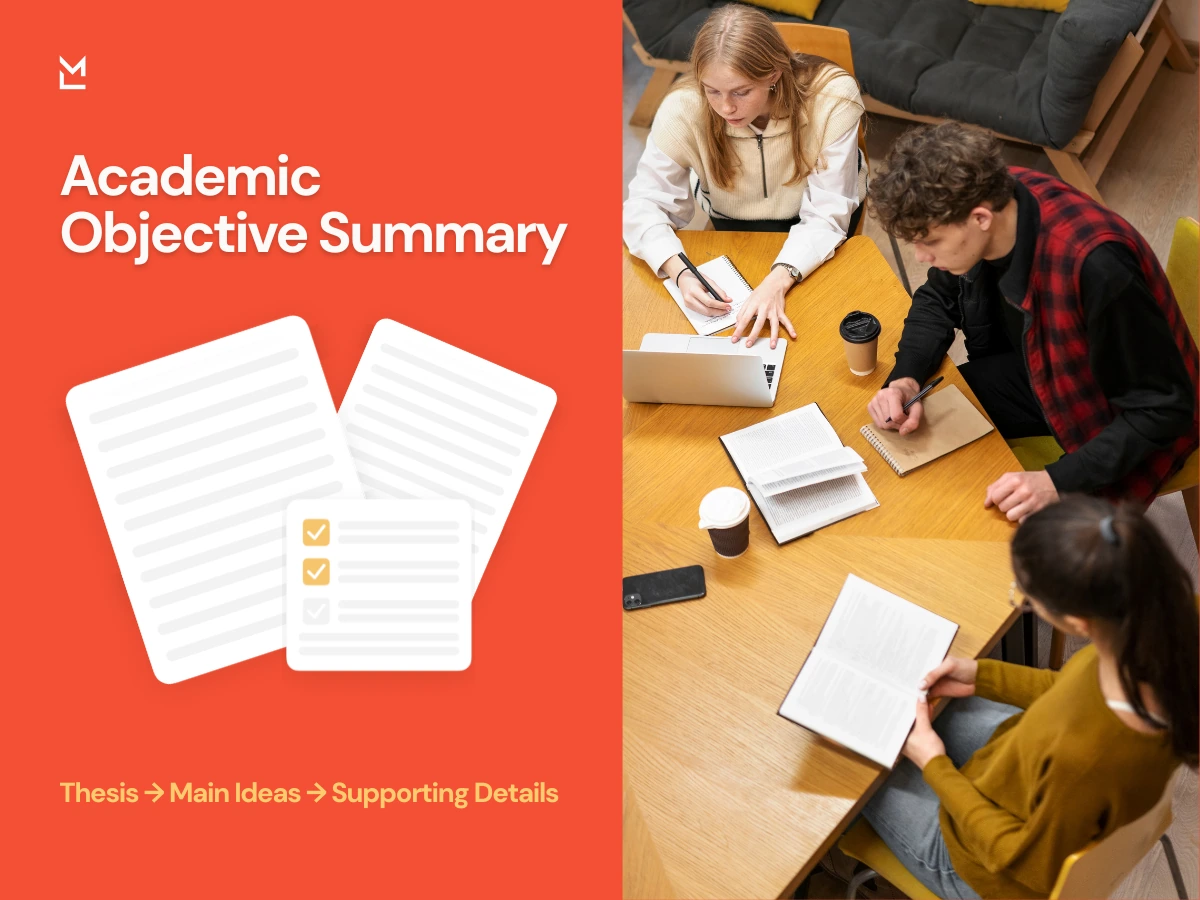
When writing objective summaries for academic work, its all about making sure you accurately reflect the source and don't slip in your own opinion. The discipline of sticking to the facts is what strengthens your writing skills and analytical thinking.
In a professional context, objective summaries show up as meeting summaries or executive briefs. A meeting summary might capture the key points that were discussed, what decisions were made and what action items were assigned.
Tools like MinutesLink can actually help by generating structured meeting summaries that highlight the essential information in neutral language - that way you can focus on the important stuff without getting bogged down in the details.
In a business setting, objective summaries are all about supporting decision making - by giving a quick overview of project updates, marketing results or design team feedback. The clearer the summary, the easier it is for teams to get on the same page.
If you're writing a resume, you might think that an objective summary is the same as a professional summary - but its not. A resume objective is all about your career goals and what you're looking for in a job - whereas a resume summary is more about highlighting your relevant skills and experience.
When writing a resume summary, the main thing is to avoid exaggerating and focus on the facts. Present your relevant skills clearly and concisely. A great summary will accurately reflect your experience and value, reject unnecessary details and highlight what's most relevant to the job description.
The terms objective summary, resume summary and resume objective may look pretty similar at first glance but they serve very different purposes and its important to understand the difference, especially in a professional setting where you need to be clear and to the point.
An objective summary is just a straight up factual summary of some source material. It's there to boil down the main ideas, supporting points and key details without bringing any personal opinions into the mix. You'll see this kind of thing in academic writing, meeting summary documents, reports and the like.
On the other hand, a resume summary is a way of scratching out the highlights of your work experience and the skills that are going to make you stand out from the crowd. It's still got to be factual but its job is to paint you in the best possible light and make your qualifications look like they're tailor made for the job you're applying for.
A resume objective, however, is all about the future - it's one sentence that sets out your career ambitions and the kind of role you're looking to get into. Its not summary of some material - its a statement of intent and direction.
To make all this clearer here is a comparison of the three:
An objective summary is about getting to the core of the original material and accurately reflecting its main message. A resume summary is about showing off your qualifications. A resume objective is about where you see yourself headed.
Getting this lot mixed up can make your writing and applications look pretty weak. Knowing the difference between an objective summary and a resume summary will help you to become a more effective writer overall.
A resume objective is usually just one sentence outlining your career goals - whereas a resume summary is a bit broader and can include several sentences on your achievements and relevant skills.
Both need to be clear and focused and avoid loaded words and vague statements. And, yeah, a professional summary needs to stay factual while still highlighting your strengths.
When you're faced with a lot of complex information, the key to a good objective summary is to break it down into manageable chunks. Identify the main argument and then outline the supporting details.

Don't get bogged down in the minor details or secondary examples - focus on what drives the central idea forward.
If the source material is really dense, its a good idea to write a first draft summary and then refine it into a shorter summary. Practising the 'revise and summarise' entire process really helps clarity and focus.
We all know how messy client feedback can be - emails filled with emotional language, scattered ideas and vague suggestions that are hard to interpret.
To turn messy client feedback into a clear objective summary, its all about identifying the main ideas, extracting the key details and removing the emotional phrasing and personal bias. This will give you a concise summary that teams can actually act on.
MinutesLink can help with that by turning discussions into structured summaries that highlight the key takeaways and important details - that way you can focus on execution rather than confusion.
Taking good notes makes it so much easier to write an objective summary later on. When youre at a meeting or reading an academic article, try to focus on capturing the key information and main points rather than transcribing everything.
Identify what actually contributes to the core message - that way you can train your mind to focus on what really matters.
A good note-taking habit will directly improve your ability to summarise accurately and efficiently. Using a bulleted list for notes can help organize important points clearly.
In some cases - yes, it's possible. If the original text makes one crystal clear point that you can easily grasp, then a one sentence summary might be just fine.
But even then, your one sentence needs to cut right to the chase and nail the main point without dragging in any unnecessary stuff. It should be like a precision strike that captures the core of what the author is trying to say.
The thing is though, the decision to go for a one sentence summary depends on what the original material says and what you're trying to achieve with the summary.
Now, I'm not saying you should be slapping direct quotes all over the place in an objective summary. There are times when quoting a key term or definition from an academic source is just what you need.
However, if you're relying too heavily on direct quotes, then you're probably not doing yourself any favours. Your job is to show that you understand what the author is saying - not just to paste key phrases into your summary.
So, aim to paraphrase in your own words as much as possible, sticking to the original meaning of course.
There are a few mistakes that a lot of writers make when trying to write an objective summary. One of the biggest ones is ending up with a summary that's full of your own interpretation - even if that wasn't intentional.
Others fall into the trap of including way too many minor details, or of not clearly identifying the main argument at all.
Another thing that trips people up is writing a summary that's just about as long as the original text - which is definitely not what you want. Your summary should be short and to the point, a much more concentrated version of the original.
By keeping an eye out for these pitfalls & avoiding them, you'll end up with a summary that's clear, strong and professional.
Objective summary skills arent just for academic papers. They're a pro skill that affects how well you communicate & are taken seriously.
In the real world concise summaries help make decisions, keep teams on the same page, and avoid misunderstandings. They save leaders a ton of time processing complex info.
In short whether you're doing a meeting summary or working on a resume - it all comes down to same basic principles: focus on whats really important, ditch your personal views, use your own words & give a clear fact-filled summary.
If you can master the art of writing a good summary it'll make you a better writer, sharper thinker & way more effective communicator whoever youre talking to.
An objective summary is a neutral summary that sticks strictly to the facts of a source material - the main ideas and supporting details. It doesn't include your personal opinions or interpretations. When writing one, your main goal is to accurately capture the original material in your own words in a way that's clear and balanced.
Regular summaries on the other hand might allow for a bit of evaluation or a subtle hint at your opinion depending on the situation. But with an objective summary, especially in academic or professional settings where credibility counts, you need to be disciplined and neutral.
There's no set rule but you're looking at a summary that's around 10 to 25 percent of the original source's length. It will depend on how complex the material is and how many points you need to get across.
It's all about proportion. Your summary needs to be a lot shorter than the original but still capture all the essential info and the main message without any unnecessary details.
You can use direct quotes but only when you really need to. Using too many quotes can make it look like you're copying rather than explaining it in your own words. You should try to paraphrase the source as much as possible. If you do use a quote, make sure it's because it's essential to the meaning - maybe because it defines something important.
One common mistake is unintentionally slipping in your own opinion through the way you phrase things. Words like "clearly" or "obviously" can make your summary sound like you're pushing your opinion rather than keeping it neutral.
Another mistake is including too much extra info that doesn't actually support your main argument. A good objective summary sticks to the main points and supporting info - it doesn't get bogged down in side stories or long anecdotes.
Improving at this takes a bit of practice. First, try to identify the main argument and core message of your source before you even start writing. Get better at separating what's essential from what's not and check your wording to make sure you're not slipping in your own bias.
If you're doing this in a professional setting - or you want to see how it's done - take a look at the way structured meeting summaries are put together - like the kind you can get from tools like MinutesLink. Seeing how clear concise and neutral communication works in practice can really help you improve.
Trusted & Secure


.webp)



.webp)
.webp)
.webp)
%201%20(2).jpg)