Written with help from MinutesLink - free AI meeting notetaker for online meetings.
Written with support from MinutesLink — a free AI notetaker for online meetings.
Meeting debt isn't about how many meetings you've got on your calendar. Its really about what stays stuck in your head after they've finished. Every unclear decision, every vague task and every "we'll come back to this later" adds another task to your mental to-do list that you've got to keep track of.
Unlike just obvious administrative duties, meeting debt hides out in your thinking. You leave a meeting and immediately jump into another task, but part of your brain is still thinking about who promised what, whether you're responsible for a follow-up or if that decision was final. And over time, this creates a heavy mental load that quietly sucks the energy and focus right out of you.
Meeting debt builds up even when meetings feel productive at the time. The problem isn't that you're not taking part in the meeting - its what happens after it that's the real issue. When meetings don't clearly sort tasks, responsibilities and next steps, they create loads of invisible labor and invisible tasks that employees end up carrying with them for the rest of the day.
Mental load is the cognitive effort that you need to put in just to manage, remember and prioritise your tasks. At work, its not just about getting your work done - its about keeping track of it. Meetings massively increase mental load because they often throw up a load of different processes all at once: decisions, discussions, future actions and all the interdependencies.
Each unresolved point gets turned into a background running process running in your mind. Its like your brain is an operating system trying to juggle multiple processes at once - so its constantly switching between processes even when you're trying to focus on one specific task. This constant context switching is a huge killer of efficiency and increases fatigue big time.
Over time, mental load starts to affect not just productivity but your physical health too. Chronic cognitive strain is a major contributor to stress, poor sleep and the reduced ability to stay focused on stuff that really matters. And meeting debt just adds to all that by piling on loads of invisible tasks with no clear boundaries.
Context switching is one of the biggest productivity killers around - every time you move from one task to another, your brain has to reset its internal state. Its similar to how a computer saves its cpu registers and updates the program counter every time it switches between processes.
Meetings are particularly jarring because they rarely end cleanly. Instead of closing one process, they go and spawn a whole load of new ones. An interrupt occurs when a meeting ends and you immediately jump back into "real work" without any proper documentation or clear guidelines. Your brain keeps switching between the meeting context and the task at hand.
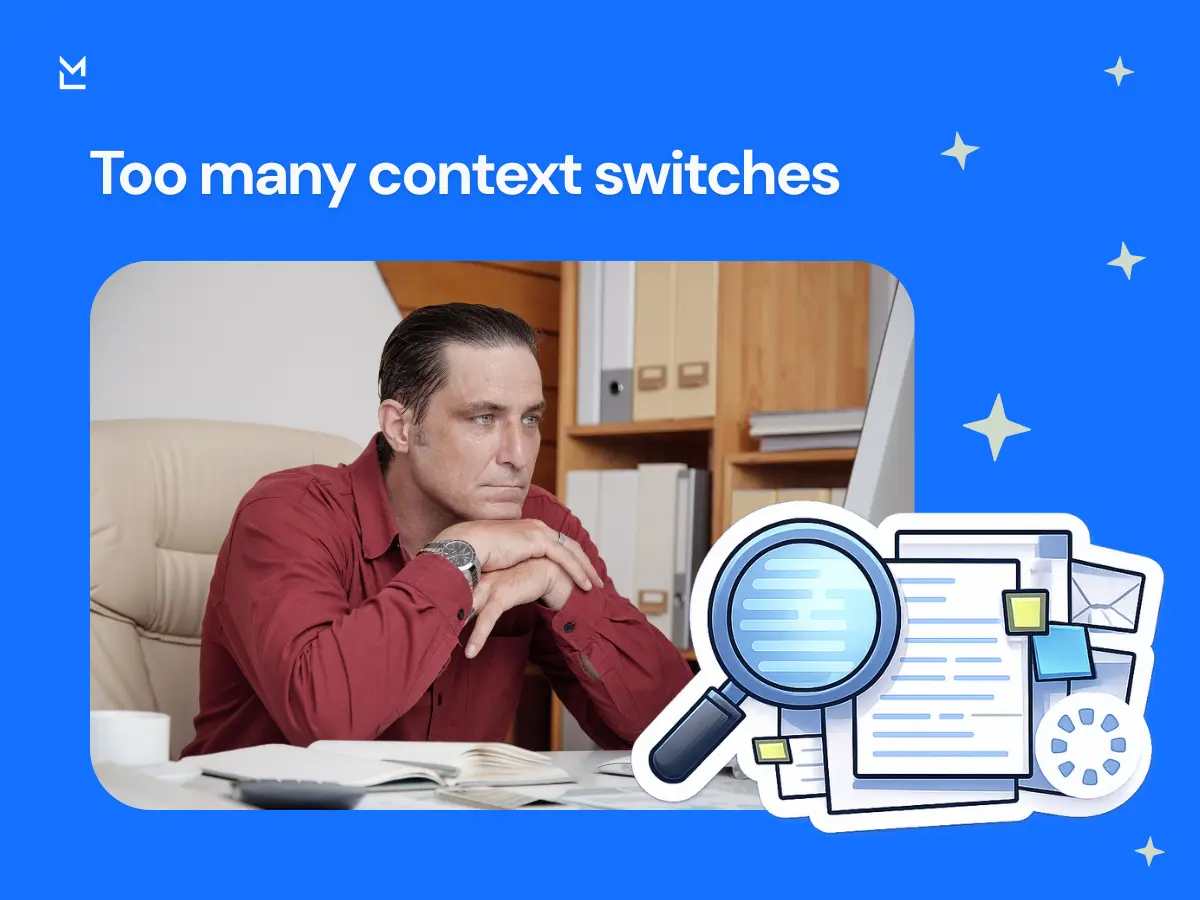
All of this constant switching reduces your ability to complete tasks efficiently. Even short meetings can fragment your attention if they create a load of tasks that aren't clearly recorded or prioritised. And over a week, all that repeated fragmentation adds up to a significant loss of focus and energy.
Every meeting creates loads of invisible tasks. Some are obvious like action items, follow-ups or updates. Others are more subtle like remembering the context of a discussion, tracking progress or mentally flagging risks that were discussed but not resolved.
These invisible tasks often aren't written down anywhere - they just exist in people's heads, adding to mental load and making time management even harder. When teams rely on memory to get things done, meeting debt grows fast.
Invisible labor is especially common in collaborative environments where responsibilities get shared around. Without clear ownership, multiple people may end up carrying the same mental task, duplicating cognitive effort and increasing overall load across the team.
Lots of productivity hacks focus on individual behavior: time blocking, the pomodoro technique, or prioritising tasks using frameworks like the Eisenhower matrix. While these time management techniques can help with managing your own workload, they don't actually address the root cause of meeting debt.
You can block out time slots for important tasks, set reminders, and carefully plan your day, but if meetings keep generating unclear outcomes, your system just breaks down. Productivity hacks assume that tasks are clearly defined - but meeting debt thrives precisely because they're not.
Time management tools like google calendar or to do lists work best when you're working with clean inputs. When meetings produce messy, ambiguous outputs, even the best tools struggle to help you stay productive.
Meetings often create administrative tasks that aren't even explicitly assigned. Updating documents, sending follow-up messages, clarifying decisions or syncing calendars all add to the workload that comes after a meeting.

These tasks don't feel like real work, but they consume a lot of time and attention. They also contribute heavily to context switching, as people bounce around between communication tools, documents and task managers.
Over time, administrative overhead becomes a running process that never really stops. Each new meeting just adds more overhead, making it harder to focus on the highest priority and meaningful work such as meal planning or project progress.
Time management tools are supposed to help us plan, schedule, and track tasks. Calendars, apps, and create boards can be really useful - but they don't do anything to ease the mental load.
The problem is that most tools assume you're dealing with one task or process at a time, but in reality, we often have to juggle multiple things at once. After meetings, for example, people often have to deal with their main task while also trying to remember all the things that came out of the meeting.
Without any decent meeting notes, time management tools just end up reflecting a bunch of incomplete data. Tasks are tracked, but the context is missing, so you're constantly having to go back and remember all the details - which undermines the whole point of these tools in the first place.
Meeting notes are a lot more than just a record of what happened. They're actually a way of offloading information from our brains and into a shared system. When done properly, they can really help reduce the mental load and cut down on context switching.
Good meeting notes capture decisions, responsibilities, and the reasoning behind them. This lets team members go back to their main task without having to worry about juggling all these different mental threads. It also helps with time management, by turning vague obligations into actual tasks.
Without reliable notes, meeting 'debt' just keeps piling up. People can feel busy and overwhelmed without knowing why.
Meeting debt grows when decisions, responsibilities, and follow-ups live only in people’s heads. MinutesLink helps teams reduce that mental load by turning meetings into clear, structured records - automatically.
Instead of leaving meetings with a dozen invisible tasks to remember, teams get documented decisions, clear action items, and shared context in one place. This reduces context switching, cuts cognitive strain, and allows people to return to focused work without carrying unresolved meeting outcomes in their minds.
By capturing what was decided - and why - MinutesLink helps meetings end cleanly. Mental load drops, productivity tools start working as intended, and meetings stop creating debt that drains energy long after the call ends.
Meeting debt just keeps getting worse and worse over time. One unclear meeting might not be a big deal, but ten unclear meetings in a row and you've got a real problem on your hands. The effort of trying to remember all the details that came out of every meeting starts to compete with your actual work.

As the debt grows, teams spend more and more time trying to figure out what was said in past meetings, rather than actually moving forward. Meetings pile up to try and resolve the mess created by previous meetings. This creates a vicious cycle that just drains productivity and morale.
People end up feeling busy, but not actually getting much done - a classic sign of high mental load and poor process management.
Our brains aren't designed to handle dozens of different things happening at once like a computer. We don't have perfect memories, and we don't have the technology to just switch between different tasks at the drop of a hat. Every time we get interrupted, it takes us a while to get back to where we were before.
Meeting debt really takes advantage of this. It turns knowledge work into a constant juggling act, where you're never actually focused on what you're supposed to be doing.
Scheduling meetings is easy, but scheduling recovery time is a different story altogether. When meetings are piled up back to back, there's no time to process the outcomes, document the decisions or prioritize the tasks.
If you don't make an effort to schedule some time to catch up and process what's been going on, meeting debt just piles up faster and faster. People go from one meeting to the next, carrying around all these unresolved mental tasks with them. By the end of the day, focus is gone and progress just stalls.
Good scheduling isn't just about finding time for things - it's about making sure you've got the time you need to actually get back on track.
Meeting debt is a process problem, not a personal failing. When teams make an effort to capture and share what comes out of meetings, the mental load just drops for everyone.
Good processes for documenting decisions, assigning tasks and tracking progress turn meetings from jumbled messes into neat, closed loops. This knocks out a lot of the context switching and lets people focus on one thing at a time.
Good processes create a shared system that works for everyone, not just the one person trying to keep everything straight on their own.
Tools like MinutesLink are actually pretty useful in this situation - not because they're another app to try and manage, but because they can genuinely help reduce the mental load. By capturing the context, decisions and tasks from meetings in one place, MinutesLink lets teams offload some of the mental effort into a reliable system.

Instead of carrying around all these invisible tasks in their heads, people can rely on structured meeting notes that actually reflect what happened - which reduces the mental load, cuts down on context switching and makes time management tools actually work.
When meeting outcomes are clear, productivity hacks start to have a real impact.
Reducing meeting debt isn't about getting rid of meetings altogether - it's about making them complete. A meeting should leave you with a clear plan, not a bunch of new tasks to juggle.
When teams document outcomes, prioritize tasks and track progress, meetings become assets rather than liabilities. Mental load drops, focus improves, and people can get on with the work that really matters.
It doesn't need to be perfect - just consistent and clear.
Over the long term, reduced meeting debt has a real impact. Less mental load means better decision making, faster execution and higher quality work.
Teams that manage their meeting outcomes well don't have to spend so much time trying to manage tasks and can actually get on with the work. They stay productive by working smarter, not harder.
That's real productivity - the kind that's sustainable, focused and actually makes sense for humans.
Meeting debt is not just something that happens to individuals - its a real challenge that leaders have to face. When you let meetings get all murky and unclear, it ends up costing your team extra work that's just not needed.
By making sure meetings are properly documented and people follow up on what was discussed, leaders can actually reduce all that extra effort people are putting in, help them manage their time better, and stop taking a toll on their team's well-being.
Its not about controlling things, its about helping people do a better job.
There isn't an app that magically wipes away your meeting debt overnight , but having the right mix of tools at your disposal & some good habits can really help make a big difference. Time management tools, scheduling apps and documentation systems need to work together in harmony and not be trying to compete with each other for your attention. When your meetings are clear cut & you walk out with a solid grasp of what was decided, what's been assigned and what you need to do next, the mental burden feels a whole lot lighter. That clarity lets you actually focus on the work at hand, switch between tasks with ease & get more done in less time.

Meeting debt isn't some unavoidable part of the job - its the result of bad meeting management & relying way too heavily on your memory to keep everything straight. By acknowledging that meeting debt is just a choice , teams can start to build systems that support productivity. Tools like MinutesLink are a big help - they can capture the context of the meeting, decisions & tasks in one place, taking a load off your mind. When you combine these tools with good habits & clear processes, they turn meetings from being a source of chaos into real drivers of progress.
Mental load is not a personal failing - it's a warning sign that something is wrong. When work systems are pushing peoples minds to the limit, their performance starts to suffer.
One of the best ways to ease up on mental load, stay focused and stay productive and keep peoples energy up is to reduce meeting debt. By sorting out your processes and using tools like MinutesLink, meetings can stop eating into peoples productivity - and start giving it a real boost.
Administrative duties are those tiny but totally necessary tasks that keep everything running - even though they never really feel like "real work". Think things like updating documents after a meeting, getting a bunch of calls scheduled, sending follow-ups to people, cleaning up your files, or tracking who's supposed to be doing what.
The problem is, these duties tend to show up after a meeting and just pile up quietly. On their own they don't seem like much, but together they add up to a ton of hidden work that no one ever talks about. When these tasks are fuzzy or not written down, they just add to your mental load and make it way harder to focus on anything more important.
Context switching is what happens when your brain has to suddenly jump from one thing to another - eg. from a meeting straight into some deep work, then back to emails, then to another meeting. Each time you switch gears it takes a toll on your brain, because it has to reload the context - what you were doing, why it matters, and where you are in the process. When meetings create all these loose ends and unclear tasks, your brain just keeps switching back to them in the background, even when you're trying to focus on something else. That's why context switching is so draining and quietly eats away at your productivity.
The best time management tools are the ones that cut down on the thinking, not add to it. Things like Google Calendar, a simple to-do list, or a task manager work okay when tasks are clear and well-defined.
But tools don't work in isolation - they only work when paired with good meeting notes and clear decisions. Without that clarity, the best tools just become another place to dump half-baked tasks. The "best" tool is the one that fits with your workflow and helps you see what actually matters - not one that forces you to remember all the context you missed.
Mental load is that ongoing effort of keeping track of everything in your head : tasks, decisions, reminders, responsibilities, and all the things that are still floating around unsaid. It's not just about how much work you have - it's about what you have to remember at any given moment.
Meetings especially add to mental load when decisions aren't written down or tasks aren't clearly laid out. Your brain just keeps running these unresolved threads in the background, which makes it harder to focus, think clearly, or feel like you're done at the end of the day. Over time, too much mental load leads to fatigue, stress, and lower productivity.
Productivity hacks inevitably fail because they focus on changing individual behaviour rather than dealing with the underlying issues. Techniques like time blocking, the Pomodoro technique, or super-strict prioritization work on the assumption that tasks are already clear and well-defined.
But when meetings generate unclear decisions, vague action items, and hidden responsibilities, no hack is going to fix that. You can try to optimize your schedule all you like, but if your brain is still stuck juggling unresolved meeting outcomes, your focus will suffer every time. Productivity actually improves when you cut down on the mental clutter - not when you try to work faster.
Trusted & Secure


.webp)



.webp)
.webp)
.webp)
%201%20(2).jpg)