Written with help from MinutesLink - free AI meeting notetaker for online meetings.
Written with support from MinutesLink — a free AI notetaker for online meetings.
Note-taking used to be afterthought stuff - the last thing you did after a meeting or tossed on some poor soul who happened to be free. Now, its a top priority, driving productivity, collaboration and actually getting stuff done. Meeting notes and meeting minutes are what keeps teams on the same page, track decisions and make sure action items dont get lost in the ether. For sales teams, customer call notes shape the sales pipeline and influence how your chasing down deals. For project teams, notes tie together discussions with timelines and dependencies across project management tools and people.
As a big company grows, meetings start to blend together into a never-ending stream of information that feeds into project management systems, CRM platforms and knowledge bases. So when the notes are bad, it creates friction everywhere. You lose progress, clarify is a nightmare, and teams waste loads of time chasing context that was never written down. So yeah, note taking has gone from a mundane task to something that actually matters.
Human notes are good at capturing the real meaning behind words. You hear the tone, the hesitation, the emphasis and the emotion behind what was said. And you can tell when someones comment is hiding uncertainty, resistance, or excitement behind a nice phrase. This context makes it possible to get at not just what was said, but what it really means in that moment.
And then theres prioritization. Human note-takers can filter through all the info, pull out whats really important, and connect ideas from different parts of a conversation. This helps notes feel coherent and intentional, rather than like trying to drink from a firehose. In all the high-level discussions, brainstorming sessions or sensitive conversations, this layer of interpretation is super valuable.
However, all this is also a weakness. Human notes rely on the note-takers attention, memory and skills. When the meeting is moving fast, people are multitasking, or the note-taker is supposed to be actively participating, stuff gets missed. Over time, these gaps start to undermine your trust in the notes.
When your team is growing, human note-taking gets harder to standardise. One person uses this template, another person records this, and one person thinks that was an action item but another person thought that was just a discussion point. This all makes it tough to track decisions across multiple meetings, or to spot trends over long periods.
And volume is another issue. Sales teams doing a lot of customer calls, dont have time to document every conversation in the same detail and consistency. And project teams with a lot going on, struggle to keep notes aligned across meetings. Eventually, notes get rushed, fragmented or just plain ignored, leading to lost follow ups and wasted effort.
All these challenges left room for AI productivity tools to jump in, not replace human thinking but to help stabilise and scale documentation.
Conversation intelligence is way more than just transcribing what was said. Its about artificial intelligence being able to look at conversations, pull out the good stuff, and structure it in a way that helps you make decisions. Instead of hoping someone remembers what was important, AI tools just do it for you.
In sales environments, conversation intelligence helps you spot customer objections, buying signals, and deal pitfalls. Sales leaders use this data to coach new reps, refine their pitch and make their forecast more accurate. In project settings, conversation intelligence helps teams track decisions, dependencies and risks across meetings.
Unlike traditional notes, conversation intelligence treats meetings as data - something you can search, compare and learn from over time.
AI meeting notes bring consistency. Every meeting is captured the same way, no matter who attends or who would normally take notes. This makes it especially valuable for teams working on repeatable workflows, like sales teams, customer success teams and project teams that need to get a lot done.
And then theres action item management. AI tools can pull out tasks, deadlines and owners, making it less likely that follow ups get forgotten. For teams managing a lot of projects or customer interactions, this reliability is a huge weight off their shoulders and helps them stay on top of things. Another major advantage of AI generated meeting notes is : they can easily be integrated with CRM systems, project management tools and internal platforms, making it super easy to search and reuse that information. Instead of knowledge floating around in documents hidden away in private folders or individual notebooks, it becomes shared company data that we can all tap into.
AI agents also play a crucial role in these workflows, helping to automate workflows by extracting relevant details from meeting notes and assigning tasks automatically in project management tools. This automation saves time and reduces the risk of missing important next steps or deadlines.
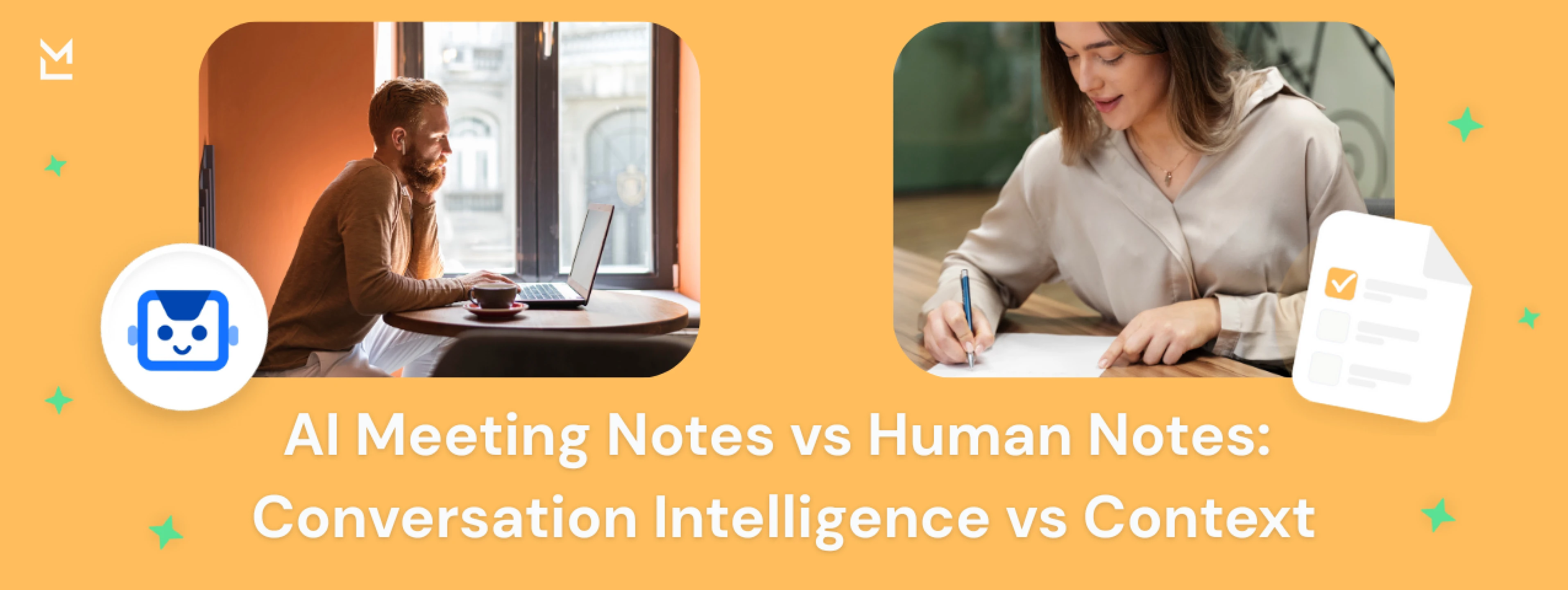
Despite all the benefits, AI-generated meeting notes are still not enough on their own. Artificial intelligence can process language, but it just doesn't get the nuances of human intent, emotion or organisation dynamics. Yes, it may be able to accurately record what was said but miss the bigger picture of why it was important or where it was heading for the team.
AI tends to struggle with things like ambiguous language, sarcasm or casual conversation where the actual meaning depends on what we all take for granted. Without human review or interpretation, AI-generated notes can be technically correct, but lacking the 'so what' factor. Its not about AI versus humans, its about how we combine conversation intelligence and human context to make something truly useful.
In reality, the most effective meeting documentation combines automation with context. AI can capture conversations consistently, structure notes, and highlight action items, while context comes from understanding how teams actually work.
MinutesLink is designed around this balance. It uses AI to generate structured meeting notes from real conversations, while keeping the focus on decisions, responsibilities, and follow-ups teams care about. Instead of choosing between speed and understanding, teams get documentation that reflects both what was said and what matters next.
This approach works especially well for recurring meetings, remote teams, and fast-moving projects where relying on memory or manual notes quickly breaks down.
Templates play a vital role in both human and AI note taking. If done well, meeting notes templates help guide our attention and reduce cognitive load for humans. For AI tools, templates define how the extracted information is structured and stored - making it easy to find and use later on.
When templates are a bit dodgy, then the notes get cluttered and hard to use - and not very effective at all. But when they get the balance just right between structure and flexibility, then notes become really valuable reference points that drive execution and learning.
Using templates in tools like Google Docs can help teams organize their meeting notes and action items consistently. Adding custom fields to these templates allows for tracking important attributes such as task owners, due dates, and priority levels, making task management more efficient.
Action items are what turn conversations into tangible outcomes. Whether captured by a human or an AI tool, action items are all about linking discussion to execution by saying what needs to happen next. One thing AI tools do really well is make action items super clear, cutting down on mis-interpretation and improving follow through.
But action items without context are basically useless. Knowing what to do is fine, but if you dont know why its important or where it fits into the bigger plan, then its not going to happen. Thats where human context comes in - and why knowing why & how is just as important as knowing what.
Sales teams are among the heaviest users of conversation intelligence. Customer calls can provide all sorts of valuable insights into customer needs, objections & intent. AI tools let sales reps focus on the conversation itself, rather than trying to take notes - while still capturing loads of detail about customer interactions.

Sales managers then use this data to analyze trends, improve coaching and help teams close deals more effectively. And yet, even experienced reps often add their own notes to capture things like relationship dynamics or gut feelings that AI cant quite put its finger on. The most effective sales workflows combine automated capture with good old human judgment.
Trust in our meeting notes is everything. Teams rely on written records as a source of truth for decisions, tasks & accountability. If the notes are inconsistent or incomplete, then trust falls apart and we all tend to fall back on memory and informal conversation.
AI-generated notes build trust by being thorough and neutral. Human notes build trust by being empathetic & interpretive. Together, they create documentation we can rely on with confidence - which in distributed teams is even more important.
Tools like MinutesLink are designed to sit right on this intersection. By capturing conversation intelligence automatically while leaving room for teams to refine the output, MinutesLink lets teams offload the mundane work of note taking but still keep the human element intact. Meetings stop being a test of memory & start being a useful source of knowledge.
We get more productive when we remove friction - not when we add more stuff to capture. AI meeting notes reduce friction by automating capture & organisation. Human context reduces friction by making info meaningful & actionable.
When our notes capture both what was said and why it mattered, we spend less time re-reading context and more time actually getting things done.
As AI keeps on evolving, meeting notes are going to get smarter, more integrated and more actionable. At the same time, human judgment & context are going to remain super important. Teams that get this will stop framing the debate as AI vs humans and start designing workflows that use both.
MinutesLink fits right in with this future by providing reliable conversation intelligence while keeping humans right at the centre. When meetings produce notes that combine structure with real meaning, teams work better, think better and build trust that sticks.
Action items are the next logical steps that emerge from a meeting. In a nutshell - what actually needs to happen after the conversation is done. A decent action item should leave no doubt about what needs to be done, who's responsible and when it's due.
Without clear action items, meetings are a lot like a jumbled mess - people leave with a sense that progress was made but it all falls apart later. Tasks get put off or completely forgotten, and momentum stalls out. Action items are what turn idle chatter into actual progress - making meetings worth your while.
Conversation intelligence is all about capturing the guts of a conversation - what was actually said, and more importantly, what it means for the end result. It's not just about getting a verbatim transcript (which nobody's ever really going to read) - it's about extracting the good stuff: action items, decisions, and context. In other words, its technical name is nothing short of a fancy way of saying meeting intelligence.
In practical terms though - conversation intelligence lets you and your team ditch the guesswork. No more replaying entire meetings in your head or trying to recall the details off the top of your head. With conversation intelligence, you can just refer to the accurate, neatly structured record of what was agreed on, when follow-ups are due and what matters most.
Using AI tools is all about freeing up mental space. Instead of squandering your focus on remembering the details or scribbling down notes, AI tools do the legwork for you so you can focus on the here and now.
When you use AI tools to grab meeting notes, highlight action items and get all the background info in order, people can just be present in the conversation and then hit the ground running afterwards. That's not because people are working any harder - it's because they're not wasting time on context switching, repetition and admin work.
Using a note-taking template is just a fancy way of saying following a consistent structure every time you document a meeting. A decent template will usually have sections for the meeting purpose, what really matters (the key points), decisions made and action items.
By sticking to a template, you avoid the need to try and capture everything - which is not only impossible but also a big time suck. It also makes your notes a lot easier to read and reuse later on, because you know exactly where to look for the info you need. Over time this consistency actually reduces confusion and makes meetings a lot easier to act on.
Creating a note taking template starts by thinking about what people actually need after a meeting - not before it. Think about what people usually flip back to later on: decisions, next steps, owners, deadlines or the context of it all.
A good template doesn't try to be a comprehensive record of the conversation - it focuses on the outcomes. Once you've got a structure that works, the template can be reused over and over, across multiple meetings, projects or even teams. This turns note taking from just a personal habit into a shared system that's all about clarity and execution.
Trusted & Secure


.webp)


.webp)
.webp)
.webp)
%201%20(2).jpg)