Written with help from MinutesLink - free AI meeting notetaker for online meetings.
Written with support from MinutesLink — a free AI notetaker for online meetings.
Let's be honest, in theory, knowledge transfer should be a pretty smooth process. But in reality, it's a super fragile thing that goes awry when someone leaves the company, a project stalls and gets revived months later, or a 3-month-old decision suddenly becomes super urgent again. Without a reliable way to keep track of context, teams start relying on our dodgy memories and well, things start to fall apart.
Science tells us that our brains are wired to remember what really matters to us - how we felt about something, rather than the specific words that were used. So we remember how a meeting made us feel, not the exact details of what was said or done. And before you know it, gaps start to form that no amount of effort can ever fully fill in. Knowledge exists alright, but it gets all scattered, personal and unreliable, and that weakens the entire team's collective memory big time.
Manual search might look like it's doing something. We might be working hard to find what we're looking for, but in reality it's a huge pain. Every time we have to search through old notes or documents, we're basically interrupting our own thought process and forcing our brains to work overtime. We go from trying to solve the problem at hand to searching for that one piece of information, and that's really expensive in terms of brain power.
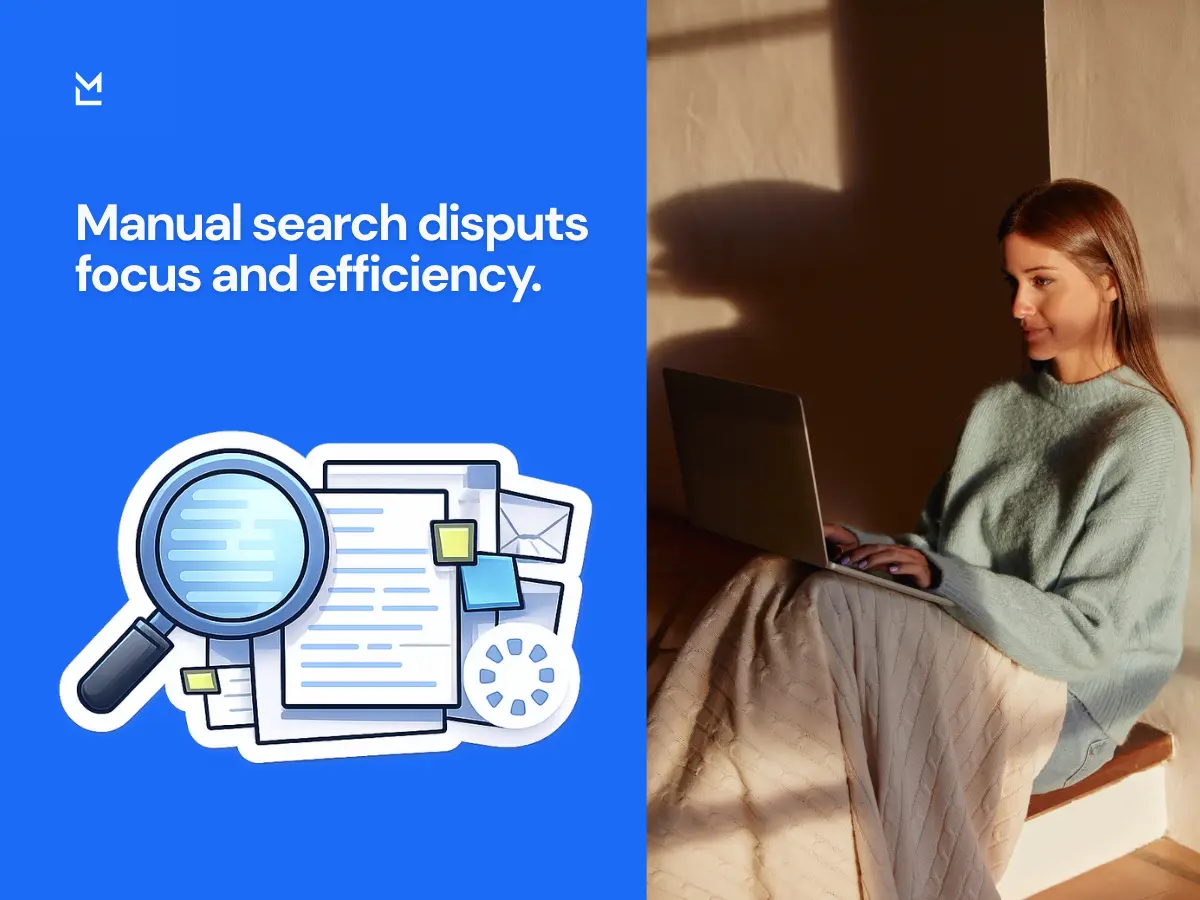
And to make matters worse, manual search relies on our own personal memory - our autobiographical memory that is. We search for what we think we remember, not what was actually said or done. If we forget a keyword, a date, or a name, the information might as well be lost forever. This is why teams spend hours re-creating knowledge that already exists, without even realising it.
Our brains aren't designed to remember every detail, that's just not how we're wired. Our selective memory is actually a survival mechanism that filters out what's not important to prevent information overload. But when our selective memory is the main way we store knowledge, important context starts to get lost along the way. Decisions start to lose their roots, ideas lose their origins and expertise gets stuck in the background.
But collective memory - that's what allows organisations to grow and learn. Societies remember through systems, records and stories shared with each other. Teams need the same kind of support. Without it, they experience a slow form of organisational memory loss, where lessons are learned over and over again and mistakes quietly creep back in.
Lost context isn't a shiny new expense - it shows up in hesitation, repeated discussions, or meetings that are just a re-hash of what happened last time. Teams know something's off, but can't quite put their finger on why progress feels harder than it deserves to be.
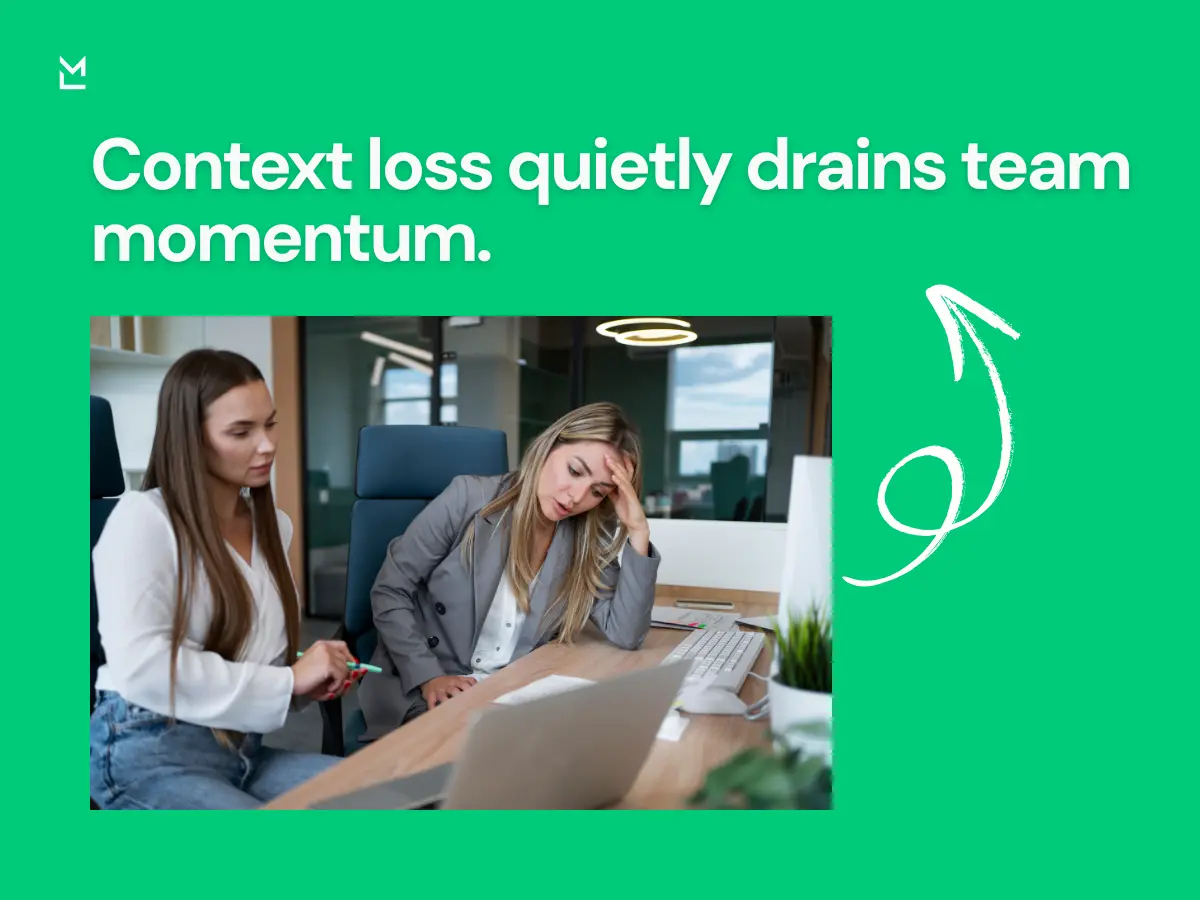
And before you know it this affects morale and culture in a big way. When people feel that knowledge disappears as soon as it's created, they start to give up on sharing their insights. Knowledge sharing becomes more of a show than something that helps people actually get stuff done.
Meeting notes templates and note taking templates promise a bit of structure and neatness, and they do help a bit. But at the end of the day, they still rely on us to be disciplined, have time and pay attention. And when things start moving fast, those resources are few and far between.
More importantly, templates don't help with recall information. Even the best-written meeting minutes become useless if people can't quickly find the right information later on. Knowledge only counts if it's available when we need it, not stuck away in a folder or forgotten document.
AI completely changes the game by working the way our brains do. Instead of forcing us to remember where the information lives, AI connects the dots between meaning, context and intent. AI finds knowledge based on what we're trying to say, not what we said exactly. Five-minute AI summaries turn meetings into a useful memory that we can actually use. They capture not just what was said, but what really mattered. This makes the whole knowledge transfer process a whole lot smoother and lets teams move at a faster pace without losing accuracy or depth.
Most of our learning doesn't happen in some formal training class - it happens on the fly between meetings, as you repeat things to yourself, reflect on what you've learned, and figure out how to put it into practice. AI summaries help out with this whole natural learning process by giving you a bit of a boost right after you create new knowledge. By providing a timely recap of what was said, AI helps teams really internalize and apply new ideas a lot more effectively, closing the gap between theory and practical use. Rather than replacing learning management systems, AI actually complements them by making the transfer of knowledge in real world situations a whole lot easier to do - without overwhelming employees with yet another thing to do.
By building AI-driven recall right into people's everyday workflows, organisations can make a huge improvement to improve productivity and also make continuous development a lot more achievable. This whole approach supports the transfer of knowledge not just during formal sessions, but in the natural flow of work as well, making sure that critical insights are still remembered and can be accessed by all other team members. The use of AI basically enhances both individual and collective memory, making knowledge transfer way more engaging and effective across the whole team, and in the end, it makes it way easier for the organisation to innovate and adapt.
Manual search breaks knowledge transfer because it forces people to rely on fragmented documents and selective memory. Even when the information exists, finding it means interrupting work, reconstructing context, and mentally stitching pieces together. Over time, this constant effort erodes shared understanding and increases cognitive load across the team.
MinutesLink removes that friction by turning conversations into structured, searchable knowledge automatically. Instead of asking people to remember where something was written or who said it, MinutesLink lets teams retrieve information based on meaning, decisions, and context. Five-minute AI recaps preserve what mattered in the discussion, not just the words that were spoken.
By keeping context, decisions, and follow-ups connected, MinutesLink helps teams build a reliable collective memory. Knowledge stops living in scattered notes and starts compounding over time, making information easier to access, reuse, and trust - without forcing anyone to manually document or search for it later.
Traditional knowledge management systems often fail because they require too much manual effort. Tagging, organizing, and maintaining vast amounts of information can become a full-time job, leading to user fatigue and eventual abandonment of the system. This creates a significant barrier to effective knowledge transfer within organizations, as valuable information becomes scattered and inaccessible. AI technology addresses this challenge by automating the capture and organization of knowledge, reducing the burden on employees. By processing the wealth of information generated during meetings, AI structures it in a way that is easy to access and reuse, seamlessly integrating into existing workflows without adding extra tasks for users.
This automation not only streamlines the knowledge management process but also enhances the overall efficiency and effectiveness of knowledge transfer. With AI handling the heavy lifting, teams can focus on applying new knowledge rather than struggling to find it. The system ensures that critical insights and decisions are preserved and readily available, reducing reliance on selective memory and minimizing the risk of knowledge loss when employees leave or projects are paused. Ultimately, AI-powered knowledge management systems empower organizations to maintain a robust collective memory, fostering continuous learning, collaboration, and innovation.
MinutesLink really fits right into modern work flows because it replaces manual meeting minutes and all those scattered notes with structured searchable knowledge that teams can finally put to good use.
The beauty of MinutesLink is it actually makes sense of relevance. Teams don't have to waste their time trying to remember where they left something or who even said it. They can access the info they need, based on context, ideas or decisions, and that really strengthens their collective memory, and reduces their reliance on selective memory.
Productivity gets totally misunderstood as being all about speed, but really, its way more about clarity. When teams can quickly and confidently recall the right information, it leads to a lot better decision making, and faster execution. Clarity means everyone's on the same page, reducing confusion and letting people do more focused work.
AI recaps play a huge role in getting rid of ambiguity. Instead of wasting your time trying to piece together what was said or decided during meetings or discussions, teams have access to one single, reliable source of truth. This reduces friction and stops misunderstandings dead in their tracks, and actually frees up mental energy so people can concentrate on real work, rather than getting bogged down trying to remember or interpret past conversations.
By making everything a lot clearer, AI driven knowledge transfer helps teams get a lot more productive and effective in achieving their goals.
The science shows us that our memory is reconstructive, and every single time we recall something, it subtly alters the original memory - especially when a lot of people are involved. Over time this just leads to distortion and conflict.
AI supported memory anchors discussions back in reality, preserves the original context, and still lets people interpret it in their own way. This balance keeps accuracy intact without stifling creativity, and lets teams build on past knowledge without arguing over it.
Innovation relies on making connections between ideas. When knowledge gets trapped in documents or peoples notes, those connections just stay hidden. AI recaps bring those relationships between discussions, decisions and outcomes right to the surface.
This means expertise becomes transferable, and innovation becomes scalable. Teams can build on existing ideas rather than having to rediscover them for themselves, which accelerates progress, and reduces the risk of wasted time and effort.
Expertise is only truly valuable when it can be effectively transferred within a team. Without a reliable system, critical knowledge leaves with individuals, creating gaps that slow progress. AI driven knowledge transfer puts that expertise exactly where it's needed, reducing reliance on any one person and strengthening the team over the long run.
The impact of AI recaps comes into its own over the long term. Teams spend a lot less time searching for information, need fewer meetings because everyone's on the same page on decisions, and make choices with a lot greater confidence. While the daily changes may seem small, the overall effect is pretty significant - teams learn faster, adapt more smoothly, and operate with way less friction.
Knowledge transfer is both a technical challenge and a cultural thing. While having the right tools and management systems is a must, the real success lies in creating an environment where transparency and trust are deeply embedded in the organisation's culture. Without this cultural foundation, even the most advanced tech can fall short in facilitating effective knowledge sharing. When people trust each other and feel safe to share their insights, questions and experiences, knowledge transfer becomes a natural and ongoing process rather than a forced task.
AI recaps play a vital role in helping support this culture of collaboration by making it dead simple to find and access knowledge. When information is readily available and easy to get your hands on, employees are much more likely to contribute their own knowledge, because they know it'll actually be put to good use. This ease of access breaks the barriers that normally stop people from sharing - things like the fear of being judged, or the hassle of documenting what you know. As a result, collaboration really starts to take off and learning becomes one big, continuous cycle that benefits the whole team. Over time, this culture of openness and support starts to get stronger, and before you know it, knowledge transfer isn't just a process - it's what drives the whole organisation forward.
Cognitive load works away in the background, quietly wrecking your performance by sapping your mental energy on finding, remembering and re-constructing information - energy you could otherwise be using to think and create. AI recaps act as your external memory, giving you back that vital mental space to concentrate on the really important work - especially when you're working in environments that are already really demanding.
Meetings often feel a total waste of time because so much of what gets discussed just gets lost as the minutes tick by and people forget. But AI changes all that by turning meetings into valuable assets that stay with the team for good. Every conversation becomes a valuable contribution to the team's knowledge bank, helping shape future decisions and keep the learning going.
As teams get bigger and more spread out, old-fashioned manual knowledge transfer just doesn't cut it. AI-powered systems step in and complement what we do by making knowledge something that's actually usable, not just a bunch of overwhelming information. The future belongs to the teams that know how to use knowledge as a living resource, not just a dusty old archive.
MinutesLink does so much more than just take notes - it makes memory and action work in tandem. It helps teams keep context without all the hassle and pain.
By plugging AI recaps into the way you work, MinutesLink helps teams keep their knowledge safe, boost their productivity and drive innovation - in a world where there's already far too much information to get through, being able to find the right information at the right time is not a nice-to-have - it's essential.
Knowledge transfer in management is all about making sure that all the important stuff - decisions, experience, and information - doesn't get stuck in one person's head. It's that process of getting information from one person to another, so your team can keep moving forward without having to start all over again every time something changes.
In the real world, knowledge transfer happens in meetings, handovers, when people are onboarding, and just in the daily mix of things. When it works well, teams are way more productive, make better decisions, and they don't repeat the same mistakes. But if it doesn't go right, people end up wasting time searching for info, asking the same questions all over again or relying on bad memories rather than being able to just look up the facts.
Selective memory is a part of how our brains just naturally work. It decides what to hold onto and what to forget. We tend to remember the things that feel important to us, are emotional or personal in some way. Small details like exact wording or times, or tiny decisions these get lost pretty quick.
In the workplace, selective memory can be a bit of a problem. The meetings and discussions that happen often include very important context that feels like no big deal at the time, but later becomes super important. That's why teams often remember the mood of the meeting but forget what actually got agreed on. If you don't have written records or shared documentation, selective memory can just replace facts with assumptions - which in turn can make things get confusing and people get out of sync over time.
A collective memory is like the shared knowledge of your whole team or organization. It's the collection of all the past decisions, discussions, experiences and lessons that everyone can look at - not just the people who were there at the time.
In a work place, collective memory lives in the meeting notes, the documentation, shared tools, and systems that keep all that context preserved. When you've got a strong collective memory, knowledge doesn't disappear just because someone leaves or a project pauses and then starts back up. Instead of relying on one person to remember, everyone can just refer to the same source of truth. Which makes collaboration smoother and makes making decisions a lot more consistent.
A good meeting notes template focuses on getting the job done, not trying to get everything perfect. It should help capture the things that really matter, not try to write down every single word that was said. The goal is to write down what needs to be remembered, decisions, key points and next steps - so it's easy to see and understand what happened later on even if someone wasn't there at the meeting.
The best meeting notes templates are simple, easy to follow and stay consistent across meetings. When people know exactly where to look for the decisions or context, they are a lot more likely to actually use the notes, rather than just ignoring them. A template only works if it actually supports people recalling information and understanding it - not if it turns note taking into some extra work.
To create a note taking template you start with one question: what will someone want to know in the future? A good template helps people understand whats happened, why it was important and what needs to happen next.
A good note taking template gives people room to add some extra context, instead of forcing them to put everything into just a few fields. It should be able to support both personal notes and shared understanding, so knowledge can easily flow between team members. When done right, a template is a tool that helps knowledge get transferred around - not just a place to store text.
Trusted & Secure


.webp)


.webp)
.webp)
.webp)
%201%20(2).jpg)